Personal Logo

Personal Logo

Tuesday, January 22, 2013

I Can Only Sell Your House if You Help

I Can Only Sell Your House if You Help Me
   Subtitle: Anatomy of a Deal Gone Bad

©Copyright 2013: Richard von Sternberg, All Rights Reserved


About a year ago I was asked to come give a presentation to a family that wanted to sell their house.  They were a nice family, well-meaning folks.  Our meeting went well and they asked me to be their Realtor® and get the job done.  I said I would do a thorough market analysis and find a price “ball-park” that would spark interest, bring willing buyers and, hopefully, engender offers for them, a price range I would offer as a suggestion based on hard data about the local market.  We set a time for our next meeting and I went off to do what I was trained to do by my many years as a property selling machine for Chase Bank.

I have sold hundreds of houses.  Selling properties for the real estate division of a bank is quite different from just listing properties on the MLS and hoping for the best with a private-party sale.  Perhaps the biggest difference is the level of expertise in the bank’s asset management departments, the very high real estate consciousness in the many people who watch every move you make from the moment you are assigned one of their foreclosed properties until you send the last message saying the escrow has closed.  From the investors who put up the money for the loans the bank makes down through the directors and managers in the bank to the asset managers assigned to work with agents like myself, there is a constant pressure to perform, to make a property sell and get it off the books.  Those of us agents who sell bank properties are literally graded on the many things we have to do to get a property sold:

--How long does it take us to get occupants in an occupied house out?
--How long does it take us to get the property cleaned, utilities on, repairs made, market ready?
--How accurate and timely is our market analysis?
--How on-time are our weekly inspections, monthly market assessments, quarterly broker price opinions?
--How well do we manage all the paperwork associated with the offers we receive?
--How long does it take us to get the property into escrow?
--How long does it take us to get the escrow closed?
--How close was the selling price to our initial estimate of value?

This is only a partial list, but it should serve to show you that your every move is scrutinized as an REO agent.  (REO means real estate owned by a bank)

When I was first offered the position, I was told that I would get the opportunity to have a small number of properties assigned to me and then be watched to see how I did.  If not well, they would cease sending me assignments.  The better I did, they told me, the more properties they would send me.

They liked my work from the beginning.  At one point I had dozens of assignments at a time which I sold and sold and sold.  I worked every day and night and slept about five hours every day for a few years until the foreclosure crisis was examined at high levels in our government due to its extreme political unpopularity and a moratorium was declared, assignments became fewer and fewer.  This history of what took place during America’s foreclosure crisis, although very interesting, is not pertinent to my present story about the necessity of a seller to utilize and harness the expertise of a good agent rather than attempt to micromanage the job of the agent through unrealistic and unrealizable expectations.  What IS important and pertinent here is that my high skill level in marketing a property is attributable to the many asset managers who were my mentors as they pressured me to constantly be circumspect, mindful and ever tightening my ship, to never overlook even the smallest detail, never veer from the goal of getting the job of selling the property done professionally, in a timely manner, leaving no money on the table.

My very first “move” was to bring a house-flipper to see the listing for his assessment of its value in the condition in which we found it when the family felt ready to list.  I told them my purpose was to establish through this contractor the cash value of their property so we might know what to expect from the very bottom of the market.  At the same time, I told them, I intend to pick the brain of the contractor to get his idea of what improvements the sellers could make to the property to make it more appealing to the market.  His lifetime of rehabilitating houses to put back on the market for profit was an important ingredient for making my new listing market-ready.  He was an expert in his field and had absolutely neutral things to say about what would be the best way to improve the house for market (such as: remove the old paneling from the walls and paint those walls white to brighten up the otherwise dark rooms)

At the end of his analysis he said he would pay 350 thousand in cash in the condition the house was in so that he would be able to make all the improvements he felt were necessary (which he spelled out for me) and put it back on the market and make his rehab profit.  The well-meaning family was offended by the amount the contractor would pay in cash and offended by the suggestions he had for its improvement because they had grown up in the house and were not able to put themselves into the neutral mind-set the contractor was used to adopting.  Thus I was given my first clue that I could expect resistance to the reasoning used by neutral parties to establish value in properties such as Chase Bank had inculcated in my thought processes due to the emotional attachment the sellers had to their property.


The main pages of a Broker Price Opinion

Next I set about to construct what is known as a Broker Price Opinion for the property as I had done several hundred times for Chase Bank. EMC, GMAC, ING Direct, Princeton Capital, and others I had sold REO’s for.  The Broker Price Opinion (BPO) is an in-depth analysis of market conditions within a tight radius around the subject property (how many similar properties for sale, what price ranges, how long did it take to sell those properties in the current market conditions, what ratio of rentals to owner-occupied, general market conditions: values increasing, decreasing, remaining stable, employment increasing, decreasing, remaining stable).  The BPO requires, for comparison purposes, three similar properties that have sold within that last 120 days and three properties that are currently for sale.  Comparisons are made between each comparable property’s features and the subject property (square footage of house as well as lot, age, views, number of beds/baths, quality of construction, condition of property, fireplace, swimming pool, landscaping, number of days on the market, price per square foot, garage, basement and so on) and each comparable property’s value is “adjusted” relative to the subject property taking into consideration in what way the comparable is different from the subject property.  For example, if the subject property has 3 bedrooms and the comparable has 2, the value of the comparable is adjusted upward.  If the comparable has 2000 square feet and the subject property has 1500, the value of the comparable is adjusted downward.  These “adjustments” are made for each feature of each comparable property until a range of values is created.  The range of values for the SOLD properties become the parameters of value for the subject property.

In other words, a scientific analysis of actual market conditions is utilized to determine the market value of the subject property.  There are actually two values called for in the BPO:  The value in the market in the present condition and the value if certain repairs are made.  The BPO has a section in which to enter the items recommended to be repaired or replaced and it must be specified how much it will cost to effect those improvements.  At the end of the BPO there is a place to put comments about the neighborhood, pride of ownership, specific market trends, anything that may affect local values (environmental issues, traffic noise, proximity to schools, etc.) and the opinion of the two values:

  1. In present condition
  2. If repairs itemized in the BPO are made

There is a place to put photographs of each of the houses used as comparables as well as photos of the subject property: front, side, back, each room in the house, street view, neighborhood shots.

At the end of my BPO for the family’s house, I showed its value to be 480 thousand in its AS-IS condition and 550 thousand if certain repairs and improvements were made.  When I delivered the BPO to the family I recommended they have a pest inspection done to the house so we all knew about conditions of the house that only an expert could tell us, thus eliminating any surprises a buyer might bring us from such an inspection.  They agreed to having the pest inspection but were shocked by my analysis of the value of their property. 

They told me they needed to get 625 thousand for the property.  This was my second indication that their emotional attachment to the property was clouding their ability to form a true market perspective.  I chuckled as I recalled the words of the office manager whom I hold in very high regard due to his decades of experience in real estate and his very abstract perspective about true market value.  I actually quoted him to the family: “What you want or feel you need are not factors of the value of your property”, and saw the tension come to their faces as I spoke those words.  I told them that their house was not worth 625 thousand dollars, but they insisted it be listed for that amount.

When I am in that position with a property owner, I tell him or her that I have a 10-day plan I like to invoke to test the market and the price they have chosen.  I say I will agree to list the property for that price, but they must agree to “revisit” the value question after 10 days in the market.  During those ten days I promise to: (a) invite all local Realtors to preview the property and tell me what they think the price should be, (b) hold at least one open house and survey each person who comes to it about their sense of value and (c) ask every Realtor who shows the property during those 10 days to provide their feedback about the property, their client’s reaction to our presentation and price, and their own sense of its worth.

In other words, I open a real dialog with the real market so the sellers can get the real feedback they need to sell into the market at the price it wants to pay.  I tell them it is a mistake to leave a house for sale at an unrealistic price because it will become stigmatized after too much time unsold due to expectations that the actual market will not take into consideration.  A high priced house quickly becomes stale on the market because, after all, real estate is a TRANSPARENT market.  All of us in the real estate profession have access to the comparables I mentioned earlier and a buyer’s agent is doing the proper diligence with his or her clients when helping to decide if a house is priced well or unrealistically.  You cannot fool the market or find a “sucker” to overpay for a property or wiggle your way around the truth of the real estate market.

I put the property on the market, held the broker tour, held an open house, called agents I knew to be looking for properties like the subject property and, in a few days, I had absolute confirmation of the correctness of the price I had recommended the property be listed for.  I received an offer within the first 72 hours for 532 thousand dollars which the family found “ridiculous and unworthy of responding to” which, as you are probably thinking, was indication number 3 that these folks were on a collision course with the truth trying to justify their position with emotions, making a detour around the reasoning process altogether. 

Several agents (20 or so) wrote me and said I had priced the house way too high.  I passed these comments along to the sellers and they scoffed at the responses.  When the ten days were up I told them it was time to have that discussion about how the market was speaking to them and that I recommended an immediate price reduction.  I will never forget the words of one of the family members as she tightened her countenance, protruded her jaw and, with scorn in the tone of her voice, said: “We are putting money into the house and you are asking us to lower the price?  I don’t think so!!!”

When I list a property I track its response from the web sites I get it on (Zillow, Redfin, Realtor.com, Wall Street Journal, Press Democrat, Coldwell Banker, CaliforniaMoves.com, and so on) to see how much activity it is getting and whether it increases or decreases.  I also create a web site myself for each property I list and send it out to my database of over 5000 people, a web site that has a much more in depth description of the property than there is room for on the MLS as well as 50 to 60 photographs that I set in a slide-show set to music (I prefer Vivaldi’s Four Seasons).  I get in-depth feedback from my web site about who is looking at it.  At the end of every week I send a weekly market watch to my clients telling them:

--How many Realtors saw this property on the MLS
--How many people from the public saw this property on the public MLS
--How many people came to my open house
--How many phone calls and/or emails came during the week
--How many people went to the web site I created
--How many people viewed all the other web sites the property is listed on
--How many actual property showings were there during the week
--How many offers came in during the week

There is a weekly total and a cumulative total provided each week so a pattern can be detected after a few weeks to see if interest is being maintained or if it is waning.  We can tell the effect of the emails I send to the database about the web site by the number of hits.  Or the effect of a price reduction because I announce those to the database.  I put my clients’ fingers on the pulse of the market their house is in so they know if they have chosen the right price.

Indication number 4 about the reasoning of my clients relative to their unrealistic pricing came when they told me that the internet was a compete waste of time, that the only people who looked at properties on the internet were time wasters with nothing else to do.  When I asked them how they felt about the feedback I was receiving from the agents who were showing the property – a unanimous feedback, indeed, that we were way over market – they responded that those people didn’t know what they were talking about.

Weeks went by and interest in their property dried up.  Nobody showed it after awhile.  People stopped coming to the open houses I was having.  The statistics coming from all the web sites indicated we were stagnating like a pond with scum floating on the top of it.  The family finally agreed to a price reduction, but they were still about 40 to 50 thousand dollars over the market. 

During this time houses began to come on the market that were on similarly sized lots, with a similar amount of square footage, but that were dressed up with today’s features (like granite countertops, stainless steel appliances, tastefully appointed kitchens and bathrooms, hardwood floors and tile, and so on) and priced 50 to 60 thousand dollars less than my listing.  This began to concern me because it was becoming apparent that the market was learning that, for less money than we were asking, it was possible to buy a much nicer home.  I sent the MLS print-outs of these homes to the family and got no response at all.

One day I got a call asking me to come meet with them and a glimmer of hope welled up inside me that they were seeing the problem and were about to do something about it.  I refreshed my market research, updated my comparisons and came to the meeting ready to suggest that they lower the price to 550 thousand, or more appropriately from a psychological point of view, 549 thousand, a price at which I knew I could sell their home in a matter of days.  I even knew which agent would bring the offer.  But, no, that was not what they wanted to talk about.  Instead they “ambushed” me and began scolding me for not knowing how to market real estate.  They reiterated that I was foolish to put so much credence in the power of the internet (which made my head fill with all the lectures I had attended and the reading material I had perused pointing out that approximately 90% of all real estate purchases now originate on the internet).  They told me that they resented my constant negative emails about what Realtors said about their pricing, the low-ball offer I had sent them and my lack of ability to bring them the “right” buyer.  They berated, scolded and took a generally hostile stance toward me until I began to feel bad.  I left the meeting feeling all my efforts had been superfluous, unappreciated and that my years of experience and hundreds of sales had no value for them.

From that day I became demoralized and felt it would not work out between myself and the sellers.  The listing was just about to expire.  I got a call telling me I would not be relisting the house and, frankly, I felt relieved.  I also felt that the hundreds of hours of time I had put into marketing the property and all the money I had spent on the endeavor had been wasted, which precipitates out as unpleasant residue in a real estate deal gone bad like this one.

After a short time the property was relisted with another company.  And can you guess how much it was listed for?  549 thousand.  The opportunity that I needed to make right with the property, the price that would have worked for me, was ripped away from me and handed to somebody else who, as no doubt you have figured out by now, worked perfectly for that agent.  The house sold right away and the final selling price was 542 thousand, an amount just a few thousand dollars more than the offer I brought the sellers 3 days after I listed the property.  Had we counter-offered, we could have sold the house at the same price 6 months earlier.

I felt vindicated, of course, but sad that the sellers had not approached our deal unemotionally as I had in the beginning.  Sad they had not paid attention to all the powerful cues I brought them from the real market, that they had not taken advantage of my expertise, that they did not see the value of what I have spent many years learning about marketing properties.


The truth is that I knew what to do to get the sellers what they wanted because I kept my emotions out of my research and recommendations.  Had they done the same, they would have had what they ended up with in less than one week.  I love real estate and the science behind it that takes years to learn.  It is a pleasure to apply that marketing science when the result is that I have been able to help somebody sell their house and complete their marketing desire.  If you know somebody who would like help selling their property, please tell them about me.  I will give them the best of all I have learned over the years.


Saturday, December 1, 2012

Can I Trust You With My Diamond?

Can I Trust You With My Diamond?
©Copyright 2012: Richard von Sternberg, All Rights Reserved


David Allen's store front at 139 N. Main in Sebastopol

Our blessed little town of Sebastopol just gets better and better with the passing of time.  People with great businesses are coming here and raising the quality bar for our local shoppers and diners.  We now have some world-class eateries, artists and viticulturists amongst us, as well as top-rated artisans.  Recently a jeweler named David Allen moved into a location on Main Street that has been a jewelry establishment since its inception as Gold N’ Gems in the 70’s. David’s store, called David Allen Designs is the 4th iteration of purveyors of goldsmithing and, in my opinion, the culmination of the evolution of this trade here. David is a world-class goldsmith (and platinumsmith) come to town. 

He is the second jeweler named David Allen I have met.  The first David Allen was a custom goldsmith also, but he lived in Blachley, Oregon and made sensational creations for his personal clients as well as important gemstone dealers, one of whom introduced me to the Oregon David: Brick Stange, no longer with us, who was with Mr. Campbell Bridges when he discovered specimens of green grossular garnet near Tsavo National Park in Kenya.

“In 1967 a British geologist by the name of Campbell R. Bridges was looking for gemstones in the mountains in the north-east of Tanzania. Suddenly he came across some strange, potato-like nodules of rock. It was like a fairy-tale: inside these strange objects he found some beautiful green grains and crystal fragments. A gemmological examination revealed that what he had discovered was green grossularite, a mineral belonging to the colourful gemstone group of the garnets, and one which had only been found on rare occasions until then. It was of an extraordinarily beautiful colour and good transparency. The find made the specialists sit up and take notice; Tiffany & Co. in New York also soon showed an interest in the newly discovered green jewel.”  (refer to http://www.gemstone.org/index.php?option=com_content&view=article&id=107:sapphire&catid=1:gem-by-gem&Itemid=14   for the whole story)

Tsavorite garnet with its frozen chlorine
gas color that captured the imagination of
Tiffany and Co., who gave it its name


Tiffany and Company was so impressed with this green garnet that they named it TSAVORITE and created an overnight fame for the gem.  Brick began marketing them here in the USA and had amassed quite a collection when I met him in the early 1980’s at his home in the Los Altos hills, a home that was castle-like with counter-tops made of slabs of fine black opal in matrix and features that left a life-long impression on me.  He opened drawers of tsavorite to show me, from small round stones measuring 3 millimeters in diameter to large, individual pieces that were so rare I felt faint holding them.  I nearly swooned for real when he opened a large walnut jewelry box (itself a work of art) containing a pendant, a ring and a pair of earrings all made of the finest, museum quality, tsavorite I have ever seen.  The pendant stone was 15 carats, nearly impossible to find in nature.  Garnets are not typically large due to the way they crystallize in the earth, but there they were—large, matching, perfect quality green grossular garnets set into magnificent gold jewelry creations made by David Allen of Blachley, Oregon.  A million-dollar ensemble.

I visited the Oregon David when I was on gem-selling trips to Oregon and Washington, stayed with him in Blachley.  When I saw the sign go up on the Sebastopol jewelry store with the name David Allen on it, I wondered if my friend had moved here from Blachley and opened a retail store.  On my first walk by the store on my way to the bank I fully expected to see a window display with tsavorites the size of door knobs, but saw none.  I wondered if it were the same David, or if there were actually another David Allen also in the jewelry business.  I found a web site and wrote the Sebastopol David who wrote back and clarified the mystery saying he had heard of the other David but was not he, adding that my name sounded familiar to him.  I wrote back and told him that I had brought the famous EightStar cut of diamond to the Western world and he remembered, suggesting we meet in person.

I went to his store to visit and found him to be quite worldly compared to the three jewelers who practiced their craft on the premises before him.  While I was visiting, a lady came in to ask a question about a ring her husband had found at a market where he was employed, that had remained in lost-and-found for a year, never claimed by its owner.  Her husband had given it to her and her question was whether it contained a real diamond or merely some simulant.  David told her that her timing was perfect because one of the world diamond experts was visiting and that surely I could tell her about her ring stone.  I looked at her ring in the microscope and, sure enough, I determined it was indeed a real diamond.

What happened next is what prompted me to write this blog post because it was a universal jewelry store moment, one that has entered the minds of tens of thousands of people all over the world as they see no alternative to parting, temporarily, with their diamond in order for the jeweler to tighten a prong, clean a ring, remove the diamond, perhaps, in order to create a new piece for it to be mounted into or other possible alternatives.  This lady, as have countless others, had heard some fear-inducing horror stories from relatives involving the cognitive dissonance created by the suspicion that the jeweler may switch diamonds, or worse, substitute a white zircon, white sapphire, colorless topaz, a faceted yttrium aluminum garnet, Moissanite, cubic zirconium, or some other diamond substitute, allowing the jeweler to essentially steal a stone and fool a client.

Has this ever happened?  Yes, of course.

If you put a gun on a table that is loaded, you could say there is something dangerous there.  Yet, in truth, the danger, latent in the gun or not, is meaningless until the gun is put in the hands of a human being.  We are all a little different from each other; some of us are much different than others.  The police officer who picks up the gun to holster and drive his or her beat to protect society presents, perhaps, one of the least dangerous scenarios as the motive behind the holstering and the usage of the gun is socially endorsed and reasonable, acceptable to most of us.  The murderer, whose motive is socially destructive, changes the metric so that it is warped by comparison to that of the officer and brings danger to the gun scenario.

A diamond placed into the hands of a reputable jeweler is safe and considered sacred as a possession of the person who entrusted it to that jeweler.  That diamond will be returned to that customer, no doubt at all.  The unscrupulous jeweler is, beyond the status of jeweler, an unscrupulous PERSON with a life agenda built on ulterior motives.  This is the wrong person to give your diamond to.  And how can you know?

To further the analogy of the gun, a weapon can be cocked and ready to fire.  People can, similarly, be “cocked” and ready to explode if betrayed.  Since it is embedded in our mass social consciousness that there is vulnerability in jewelry stores where the owner is unscrupulous, a diamond-switching betrayal, once discovered, pulls the cocked trigger in us and makes us broadcast as loud and far as we are able what has happened to us, triggers fear and scorn for the betraying jeweler and, almost instantly, explodes his or her reputation and implodes his or her business.  In short, a diamond-switcher cannot make it in business.

I could see the concern in the lady’s face and, at the same time, read David Allen’s countenance for his macro perspective of this common cognitive dissonance, this fear of loss.  And as I suspected, out of the mouth of the customer came the words set there by two of her relatives who had passed along our customary social diamond-switch phobia.

I had a different context to frame David in.  I already knew that he had been in the business for decades and that his background was one any jeweler would be proud to have.  About the same time I got into the gemstone business in the late 70’s, David went to work for an up-and-coming jeweler on the San Francisco Peninsula named Tim Fidge who “founded the original custom jewelry shop, ‘Gold Fever,’ on Hamilton Avenue in Palo Alto in 1976. Three years later, the store moved to Town & Country Village shopping center in Palo Alto, and in 1985, he changed its name to ‘Timothy Fidge & Co.’”

Tim died in a plane crash while still a fairly young man, leaving his wife to run the business.  And what a business it was.  Tim was a smart risk-taker, a quality, when combined with good luck, can propel a business owner to great heights.  In the early 1980’s I was approached by a missionary who had gone to Brazil to spread her religion in a remote area of Minas Gerais.  While there she found that local villagers lived in poverty but had access to riches since 80% of the Brazilian gemstones were mined not far from their village.  (Brazil supplies a SUBSTANTIAL amount of gem rough to the world: aquamarine, tourmaline, topaz, amethyst, chrysoberyl, alexandrite and others).  This distaff missionary conceived an idea that, by itself, lifted her host village out of poverty. 

She saw that huge amounts of topaz were being mined and cut nearby and made a proposal to the company in charge of production asking to be “fronted” a large quantity of topaz she could take to America and sell.  As she moved around America she was guided to gem dealers in each area and our paths crossed when she got to the San Francisco Bay Area.  She was carrying thousands of carats of the most beautiful imperial topaz available, clean material cut well, saturated with great color, and offered it to me cheaply.  I had four salespeople at the time and wasted no time calling them in to get their parcels of topaz to go out on the road with to offer to retail jewelers.  America was in a recession at the time, so it was difficult to get retailers to commit to purchase anything.  They mostly wanted it consigned to them, but I priced it to sell, not to consign.  I priced it so low, that a smart retailer could be guaranteed an almost obscene return on investment.  Still, smart or not, those retailers were too afraid to commit to any large purchases, so each salesperson on my staff was able to sell one piece here and one piece there.  However, my salesman who covered the peninsula went to Tim Fidge’s store and struck pay dirt, so to speak.  Fidge saw the opportunity for what it was, recognized this as the opportunity of a lifetime and bought everything my salesman had with him and then called for more.  After watching Tim demonstrate his entrepreneurial prowess, it came as no surprise to me that he quickly rose up the ranks of the jewelers and was soon in the league of the other major retailers south of San Francisco such as Gleim the Jeweler, Steiners and Sally Morton, retail establishments catering to serious jewelry buyers begun by grandparents of the current owners, and became, during the first generation of store ownership, one of America’s most important jewelry store owners.

It was with Tim Fidge that David Allen became a master goldsmith and, after a few years, ran the entire goldsmithing operation for Tim.  David was entrusted with one of the most important parts of Fidge’s operation and shined there.

With this in mind, I chuckled to myself as the lady with the found diamond expressed her concern about leaving her ring with David.  He addressed her fears appropriately and I told her she had nothing to worry about, but, of course, because there is a universe of space between all minds in the world, how would it be possible for her, or anybody for that matter, to know David’s background and put him in the context of a trustworthy jeweler?  Because I spent so many decades in the trade, I have that context in my mind and I know that David is entirely trustworthy, competent, able, and has a goldsmithing history that is the envy of jewelers everywhere.

That lady left her ring and was able to pick it up the next day, happy about finding the ring, happy about finding the right jeweler.  And, best of all, it happened in my little town of Sebastopol where life just keeps getting better and better.

Friday, September 28, 2012

Ice Cream so Amazing it Gives you the Chills

Ice Cream so Amazing that it Gives you the Chills
©Copyright 2012: Richard von Sternberg, All Rights Reserved


I grew up in a household where we were expected to do our best all the time.  My mother and father were both over-achievers and were propelled by this do-best philosophy all through their lives.  My father graduated from Stanford with a 4.0 GPA in 1924 and became a doctor, a pharmacist and the owner of an ambulance company all at the same time.  My mother started out as a stenographer at North American Aviation Company and worked her way up to become the confidential secretary of the president of Rockwell.  I felt like there was always something pushing me along to keep making things right and it was many years before this became part of my character rather than a force I tried to resist.

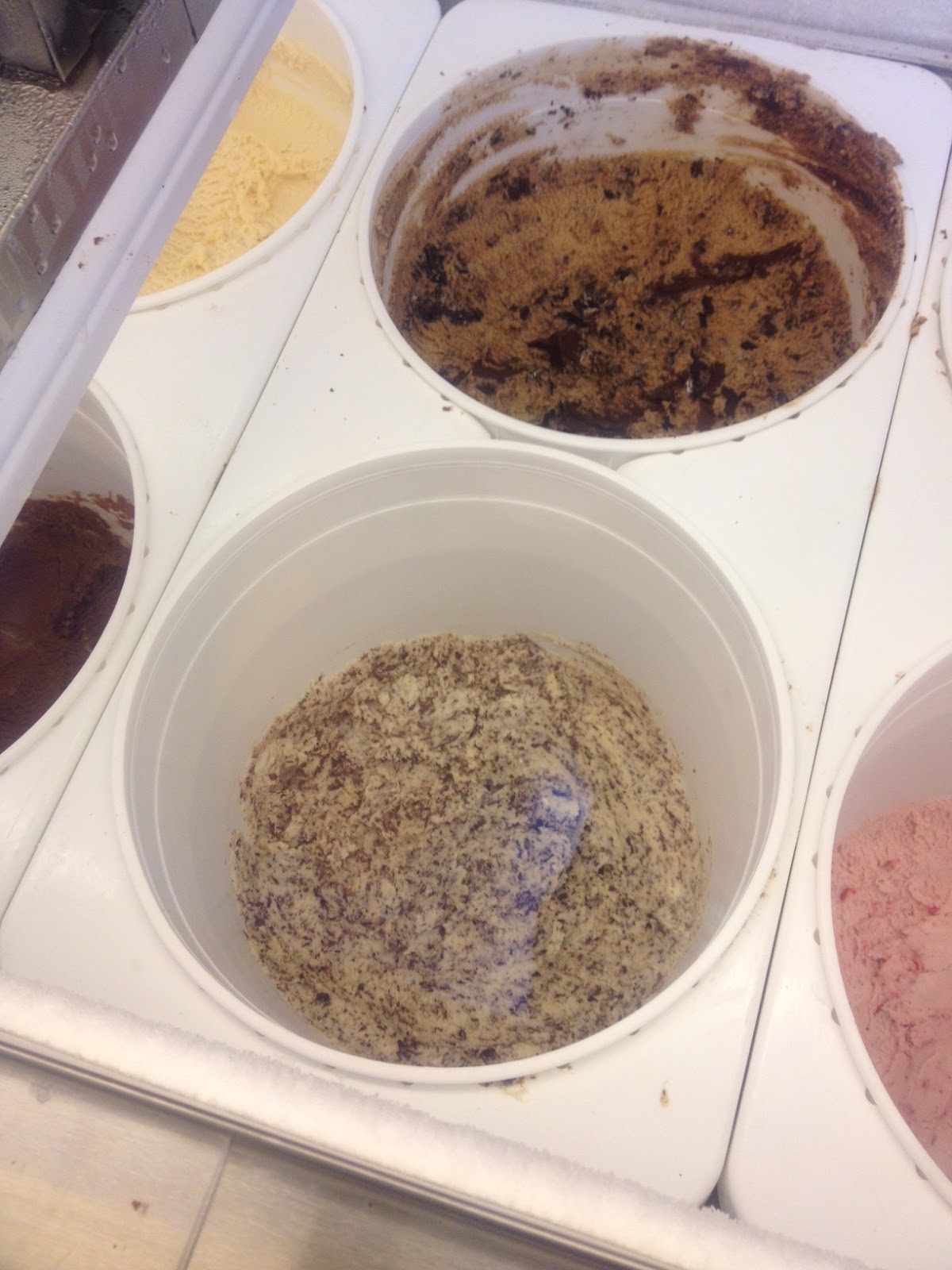
I have a radar for this personality type and appreciate those who strive to achieve greatness.  Perhaps this explains why my first trip to a new business in my town of Sebastopol was so deeply gratifying.  On the corner of the two highways that criss-cross each other in the center of our little town, where there used to be a T-shirt shop called Gone Tropo, one day in 2005, as I passed along I saw a sign on the building that said Screamin’ Mimi’s and wondered what on earth that might be.  I parked the car, walked back to the intersection and saw it was an ice cream store, an exciting find indeed.

Years before, when on a selling trip in my colored gemstone business to central California, I had stumbled across SLO Maid, a gourmet ice cream shop on the main drag of San Luis Obispo.  Ice cream stores are tough for me to not go into.  I was amply rewarded by a quality of ice cream I had not tasted since I was a little boy.  I made it a point to go to this particular store every time I was selling gems on the central coast until one day something happened to the quality and the ice cream seemed watered down, perhaps to increase profits.  I am not sure what it was, but whatever it was caused the death of the business and SLO Maid shut its doors.


I remember wishing we had something similar to SLO Maid here in Sonoma County.

And there was the jewel I had been dreaming of, right there in my little town.  Fearing yet another disillusion, I asked for a sample of chocolate chip ice cream. “We call our chocolate chip ‘Galaxy’”, I was told by the proprietress who had only recently opened her door. Skeptically I put the tasting spoon into my mouth and…..WOW!!!!!!   This was the real thing, the best I had ever tasted, bar none.

I asked Maraline Olson, that proprietress, (Mimi) how she had come to bring everybody’s ice cream dream to our little town.  The way she told it, she had come here from New York wanting to settle and was studying business at Santa Rosa Junior College when a professor advised his students who wondered what business to go into to delve into something they loved and felt passion for.  When Maraline heard those words, ice cream came to mind.

The recipes available for home-made ice cream exist in the thousands, perhaps the tens of thousands and they mostly lead you to duplicates of mediocrity ubiquitously available all over our planet.  Maraline had to rise far above mediocrity to make something special happen in her world, and she set about to create her own recipes.

I will never forget the look on her face when I asked her what her formula consisted of.  Her warm and knowing smile disappeared from her face to be replaced with a look you would expect to see on the countenance of an agent of the National Security Agency who had just been asked about America’s most guarded nuclear secrets.  She did not ask me to leave, but had I pursued it further, my guess is that she would have turned away and left me standing there.  Instead we both smiled at each other and I ordered the biggest milk shake she could make me out of Galaxy ice cream.

I owned a diamond factory in the county seat (Santa Rosa) at the time.  My drive home took me by, you guessed it, Screamin’ Mimi’s every day of the week and I took full advantage of my new find and repeated my Galaxy treat daily.  I could not believe how perfect and smooth that ice cream was, how awesome the taste, texture, richness.  It was one of those experiences that make your senses report to you that you are experiencing something world-class, something that is the product of another human’s passion to achieve greatness.

Slowly but surely people began to flock to Mimi’s from Sebastopol, from other Sonoma County towns, then other states and other countries.  Maraline put a map up on the wall along which the line forms to order up your treats.  She provided little colored push pins for customers to insert on the map indicating where they came from.  I am including a photograph of that map, still there, showing that Mimi’s fame now reaches around the world.

Hats off to anybody with that special, highly revered quality that puts him or her on a path to greatness fueled by the kind of passion we all admire.  Hats off to the business professor who pointed to that path and suggested Marline follow her passion.  By doing so, Maraline Olson has become a pillar of our community, inflexible in the quest for quality, forever devoted to the highest standards there are.  If you like ice cream, you will be floored by the Screamin’ Mimi’s experience.  Trust me.

Here is how she puts it:

Our Purpose at Screamin' Mimi's . . .

      Ice cream is fun, but we take it seriously! Our passion is to make the very best ice cream and sorbet in the world. We feature the finest, all natural ingredients from all over the world including fresh products from Sonoma County. We can taste the difference and we think you will too.


Richard von Sternberg
September 27, 2012

Saturday, May 5, 2012

A West County Valley that Cannot Change

A Valley that Cannot Change
©Copyright 2012: Richard von Sternberg, All Rights Reserved


I will return to my story about the revolution that took place in the world of diamonds with my next blog posting.  Meanwhile, I would like to help celebrate a local hero who, like many others, worried we were developing our country to death with neighborhoods and mini-estates, turning our backs on our rural beginnings.

North of San Francisco about one hour, in the area known as “West County”, there is a tranquil Wine Country valley, gently nestled in the hills to the west of Santa Rosa that separate the Santa Rosa Plain from the Sonoma County coast, a valley named Blucher Valley.  The main road that connects Blucher Valley with the rest of the county, Bloomfield Road, descends into it after climbing uphill from Gravenstein Highway passing small roadside businesses, rural residences and a school past which the road narrows, changing from semi-rural to full-blown rural on its way past former apple orchards, current vineyards and Christmas tree farms.

At about the same place where Bloomfield Road actually touches Blucher Valley, Blucher Valley Road, not surprisingly, also touches the valley.  Ironically, the main road through the actual valley is Canfield Road, not Blucher Valley Road.  Blucher Valley Road, like Bloomfield Road, descends into Blucher Valley along Blucher Creek as it meanders through the canyon where it origniates and crosses Canfield Road on its way to the Laguna de Santa Rosa, in the middle of land that once belonged to a gentleman known locally as "Bud", born Bernard Nahmens in the valley about a third of the way through the 20th century, October 19, 1931.  The house he lived in is still standing on Canfield Road, down a hill below its crest.


House where "Bud" was born


On a hot summer day, when the temperature hits the century mark in Santa Rosa, the little valleys to the west which are, like Blucher Valley, affected by the marine influence of the icy Northern California waters of the Pacific Ocean., get into the high 70’s and low 80’s.  Summer night temperatures are in the 40’s and 50’s and, as in most areas of Sebastopol, it can be “drippy” in the morning after the late afternoon overcast has covered the area.  Evidently Pinot Noir thrives in this climate as did the Gravenstein apples grown here from the late 1800’s.  Kendall-Jackson planted their first organic Pinot Noir vineyard at the western end of Blucher Valley on a square mile of land that was one of the last land grants in California, one owned by the Carrillo family, famous in Sonoma County, headed by the son-in-law of Mariano Vallejo.

It is chilly here and a bit windy compared to Healdsburg or Sonoma, areas known for their summer heat.  Hence “Bud” grew up in one of California’s magical microclimates where agriculture flourishes, at a time when families owned dairy farms and ranches of hundreds of acres or even thousands of acres. 


Bud’s mother and father came here from an island community in the North Sea named Föhr where people either farmed, fished or hunted whales.  During the rugged North Sea winters, the daytime temperature averaged about 35 degrees.  Summer days that got beyond the 50’s were pretty rare.  Days in the 60’s probably talked about for weeks.  For George and Tita Nahmens who began their life in Blucher Valley with a dairy and poultry farm on Canfield Road, discovering the little valley's microclimate must have seemed like the final shedding of a case of the Winter Blues that most Californians have never had to suffer or even imagine.

The Isle of Föhr in the North Sea


Mr. and Mrs. Nahmens were descendents of rugged island folk dominated centuries ago by Dutch conquerors, and later, Prussian ones, people who spoke German as well as their own native language.  They were not at all unfamiliar with adversity and had no problem settling down to a life of honest muscle-straining work that required constant attention, during a time when people had to be resourceful and creative to address daily “fix it” mini-crises inherent in country living, especially so before the ushering in of the super store with everything, like Home Depot.  They were resourceful country folk who made it comfortably as they passed through the Depression and World War II, folks living a sweet life in the coastal foothills of Northern California.  They were farmers in an era when DDT was a commonly-used pesticide, when weeds were to be eradicated, when war was declared on all pests. 

In spite of this, Bud was a visionary who grew up loving his surroundings.  His parents taught him well, nurtured his instinct to live harmoniously and in balance with nature to the extent that it became part of his life philosophy to leave the land better than he found it. Bud became an adult in a time when DDT was outlawed in America and, possibly due to this, evolved to a higher level of understanding of the intimate relationship between ourselves and the land we draw our life from.  He took over the dairy operations from his parents in 1962

As you drive through this little valley it appears that nothing has changed in decades, save for a few spendy custom homes.  To quote one of my real estate clients who stood on a hill overlooking Bud’s valley: “It reminds me of the old California”.  When George and Tita built their ranch in the 20’s, there were national programs to electrify rural America and extend the postal service with the Rural Free Delivery program.  People lit their homes with gas and kerosene lanterns and cooked on woodstoves.

At some point the electric lines and phone wires arrived and lives changed almost as much as they did with radio and television.  Times and philosophies underwent a kind of kaleidoscopic transformation during the 1960’s that tugged at the heartstrings of many local farmers and pulled them into the organic movement here, gave them a new kind of respect as they took on a role loftier than mere agribusiness: "Bud's goal was to preserve the land. He always felt farmers were the best stewards of the land in Sonoma County," said his wife, Janet Nahmens (this quote is from an internet eulogy)


The most sensitive side of Bud surfaced when he came to know of the endangerment of the Sebastopol Meadowfoam flower.  Bud actually took steps to change the way he farmed in order to preserve this endangered species.  His concern for the local watershed made him embark on a restoration program for Blucher Creek, an activity for which he was honored by Nature Conservancy in the late 1980’s early in his retirement from dairying.  In the mid 1980’s he sold his dairy herd and switched to beef cattle.

I remember when that happened.  I never met Bud, but the view from my living room window includes the Kendall Jackson vineyard I mentioned earlier as well as Blucher Valley.  When Bud made an arrangement to preserve his land for agricultural purposes, when he “Preserved his land by selling his development rights to the Sonoma County Agriculture Preservation and Open Space District.”, he froze history and moved very high up my list of heroes.  Because Bud, who died March 10, 2004, chose not to sell his land to land sub-dividers and developers, my beautiful view will always be beautiful and the valley will always be the valley.

Richard von Sternberg
May 5, 2012

Monday, April 16, 2012

The Birth of the Eightstar Diamond

Much More Beautiful Diamonds—Part 3
Birth of the Eightstar Diamond

©Copyright 2012: Richard von Sternberg, All Rights Reserved

In my last blog post, which I called “Much More Beautiful Diamonds—Part 2”, I spoke about a little of the life of one of the most powerful people I have met in my lifetime, Tamura-san, a man who brought the Eastern way of Japanese thinking to Western-style diamond cutting and polishing.  Tamura discovered a hole in the logic of diamond quality analysis – as far as it relates to the quality of the cutting in particular – that was so broad, it appeared as a house of beautiful features built on a foundation of untruth. This gentleman entrepreneur elevated Sony from not much more than a business plan to a giant phenomenon, a world business model, retired, and embarked on a quest for perfectly cut diamonds. During his hunting campaign he struck out in more than one country and changed the course of diamond cutting history profoundly and forever when he decided to open a cutting factory in Tokyo devoted to making every diamond optically perfect.


Mr. Tamura, Diamond Revolutionary

When he began, he knew more about diamonds than anybody else in the world and also knew less about diamonds than the people he originally thought of as experts.  As much as this may seem a contradiction, the fact was that he knew nothing of the components of the octahedral carbon crystal, nothing of the dops, tangs and scaifes that were the stuff of the diamond polishing industry, nothing of the refractometrical “critical angle” of carbon that Tolkowsky the physicist (and others) postulated as the basis of ideal diamond cutting, He had developed only a very rudimentary knowledge of the mathematical ratios between the table diameter, the depth and the overall diameter of the diamond or the ideal angles of the 8 main facets on the crown and the pavilion of the diamond.  His knowledge of the color grade or clarity grade of a diamond was beginner level.


Yet his 60 thousand (or so) looks through the Firescope at real diamonds had systematically developed a three-dimensional consciousness of the cutting of any diamond, 60 thousand intuitive, straightforward looks at the truth of how a diamond was cut, unmistakably clear even to the untrained eye.  His knowledge was cumulative as he learned something from every look into the Firescope.  He learned developmentally through his viewings to recognize patterns that explained what he saw.  

After his many months of observations and learning-by-doing, he was in a class by himself for a time.  From his self-created lofty, heretofore unknown perspective, Tamura sculpted a vision of diamonds so avant-garde, so revolutionary, that it would be years before the mysterious and esoteric diamond industry would catch up to it.  His vision would come to shake the entire diamond industry and, abetted by the simultaneous revolution in information dissemination -- the Internet -- cause it to reinvent itself after 500 years of tradition.

He began his experiment in Yotsuya in his Pyramid building with the help of Mr. Higuchi, a cutter of sapphires and diamonds whose reputation was golden in Japanese cutting circles.  Tamura did not need to make money because he was already comfortable.  His motivation to succeed was Quixotic in that it was based entirely on a personally-developed ideal that began in his heart: a dreamy ideal about rescuing diamonds from the shabby way they were cut that prevented them from being the beacons of light he knew they could be.  Therefore, when he hired Higuchi-san, he fulfilled an impossible dream for him by allowing him to acquire everything he thought he would need in order to make diamonds sparkle in ways nobody thought possible.  All the equipment, powders, dops, tangs, cutting wheels, girdling equipment, acids for boiling and cleaning diamonds, measuring devices, lenses, lighting, practice diamonds………anything he needed was made available to Mr. Higuchi.


Mr. Kiyoshi Higuchi

Tamura explained to Higuchi what it was that he wanted to accomplish, let him look through the Firescope at several diamonds, showed him the 3 little diamonds that he had discovered cut perfectly by accident and asked him if he thought he could cut all diamonds this way.

“I think so,” he replied.  He told Tamura it would take him some time to understand what he needed to do to make them appear the way they needed to look in the Firescope. His task was to cut diamonds to have three-dimensional optical symmetry required to send light to all the proper places, in the proper order and end up making a BANG as it emerged from the diamond, lighting up the eyes of its viewer.

Higuchi was calm, centered, inquisitive, experimental, methodical, intuitive, he was the kind of person a Westerner conjures up in his or her mind when thinking of Zen. He began to wrap himself around his challenge from the first minute, picked up his master’s calling like Sancho Panza did that of Don Quijote, and set out to change history.

At the end of his first day, and the next, and the following dozens, Higuchi got nowhere, made no progress at all.  If you study the Firescope photograph a little, you will see that there are two patterns of black “arrows”.  There are 8 of them inside the inner circle you see and 8 outside. The inner arrows are reflections of actual facets. Those 8 inner arrows show you if the 8 main facets on the bottom of the diamond are of equal length, width and have identical shape.  More importantly, however, those facet reflections tell you if the facets are plumb and have correct caster and camber relative to the imaginary axis from the top to the bottom of the diamond.

Diamond cutting pioneers of the 19th and 20th centuries contributed to a generally accepted hypothesis that the angle of the bottom main facet needed to be at 40.75 degrees relative to that imaginary axis.  40.75 became the magic number on the bottom of the diamond, 34.50 became the magic number for the top main facets.  These were the “targets” of the ideal cutter.  These were Higuchi’s targets.  He aimed at the targets, achieved them, put the finished diamond into the Firescope and saw the telltale white areas where light was simply passing through the diamond instead of being placed on the conveyer belt of the scientific light path through the diamond.

At first Higuchi doubted himself.  Was it bad cutting, bad measuring?

Go back to those black arrows in the Firescope image.  Think of any one of them as the reflection of something that you can move around with your computer.  You can move one of the arrows left or right, up or down or twist left or right from its place, the way an airplane does when the pilot “banks” the plane.  The plane can bank to the left or the right depending on which direction the pilot is turning the plane. 

If you look at the black arrow and think of banking to the left or banking to the right, like an airplane, you are keeping the facet on one plane, but changing its attitude three-dimensionally.  If the facet is applied to the diamond this way, where it may be the right length, the right shape and be placed at the right angle, if it is banking to the left or right, it is twisted away from its correct light-path direction and will allow light to pass through the diamond at that point.  One facet being applied this way would corrupt the perfect pattern you see in the enclosed photograph creating one small area of light leakage that drains away beauty from a diamond, in Tamura’s perception, the same way a hole in a boat makes the boat sink.

Higuchi’s facets did not just bank to the left or right, they were not all the same length, they were not all the same shape and did not appear symmetrical the way the photo in this blog post does.  In that imaginary computer program I spoke of earlier, where you can move the facets around any way you like, ANY movement of any kind away from perfect was wrong as far as Tamura was concerned.  The star formed by the arrows, the eight-rayed star, was the stimulus for the name Tamura gave his diamond: the Eightstar diamond.  Because of this, all diamonds had to look the same in the Firescope or they did not pass quality control, meaning Mr. Tamura’s eye. 

Diamond Cutting Equipment
M.G.M & Company
He began with standards that no diamond cutter on earth knew how to meet except by accident.  The equipment that a cutter uses is “adjustable”.  While it holds the diamond in place with a dop, the hand-held cutting device, known as a tang, can be adjusted in several places to change the angle at which the diamond makes contact with the rotating scaife, the metal wheel incrusted with tiny shards and fragments of crushed industrial diamonds, called “bort”.  The wheel spins and the diamond is laid against the abrasive spinning surface beneath it much the way a piece of wood is set against a piece of rotating sandpaper on a sanding machine.  Just as the wood is sanded away by the abrasion of the rotating pieces of garnet shards in the sandpaper, diamond is sanded away by the action of the tiny diamond shards.

In the background, however is the biggest problem for the cutter attempting to apply a facet that is symmetrical from the perspective of all three dimensions: the grain of a diamond.  The grain in the wood forces the woodworker to turn the wood a preferred way to get the smoothest surface, or to consider whether to cut with or against the grain, or what to do about a knot.  Diamonds have grain and knots as well.  The trouble is that it is impossible to cut a diamond against the will of its grain because you are dealing with the hardest substance in the universe we know of so far that can be mined in mass quantities and sold through a hugely profitable chain of distribution through cutting companies and jewelers around the world.

Cutters in factories over the centuries knew hundreds of years ago that grain direction in a diamond constricted their cutting possibilities.  If you are attempting to cut a facet and you find that you are working against the grain, you have to take advantage of the fact that grain is directional.  You can adjust the equipment so that the plane of the facet changes even though its angle stays the same.  You bank to the left or right, and the cutting begins to occur.  In one direction you can put the diamond on the cutting wheel and go out to lunch, in another country !!!!!   A diamond has some directions in which is simply will not cut.  Twisting the facet a little allows the diamond to be placed on the wheel approaching the grain from a slightly different direction which achieves two things at once:  it simplifies the process for the cutter while it corrupts the three-dimensional symmetry of the diamond.

Soon it occurred to Higuchi that it was necessary to know more about the grain of a diamond than anybody had been able to learn to date.  Since grain is not something you can see with your eye, you have to “experience” it during cutting.  Tamura’s cutter began to lay the ground for the first scientific rules of optical diamond cutting by placing a facet on the wheel in one direction (imagine looking at a clock and seeing the facet like a hand on a clock in the 12 o’clock position).  He would choose a particular clock direction, apply the facet to the wheel and study the facet to see if it was cutting in that position.  Then he rotated one clock position and did that with every facet on the diamond, including the table, until he had built a huge compendium of information nobody knew exactly how to sort out.

By learning what diamonds did in certain directions on one facet relative to others of the 58 facets, he ascertained a method of knowing where to begin the cutting on the diamond so that every direction he turned it allowed cutting to occur according to the three-dimensional boundaries of angle, shape and banking to the left or right.  He labored for months, almost two years, grinding through many parcels of diamonds, turning them into dust, losing them entirely to science and experimentation before he was able to achieve the results Tamura was very anxious to hear about.

Tamura had set the parameters with the Firescope so that there was only one way a diamond could look.  Perfect or not perfect as Tamura saw it.  On the first day of work Tamura gave this speech to the staff:

"The diamond I want has absolutely nothing to do with the diamonds on the market today.  If I'd wanted diamonds like that, I would never have bothered setting up a factory in a place like this.  In fact, I would never have set up a factory at all.  What I want you all to understand today is why we are here, and the significance of what we are about to do.
            "The diamond I want has to appear completely red under the FireScope, with a sharp, clear eight-pointed star floating in the middle.  It has to be sharp and clear.  I'm not interested in more-or-less.
            "I'm a complete amateur when it comes to diamonds.  I know next to nothing about polishing, so some of the things I say may strike you as nonsense.  Believe me, though, when I say that I'm putting my heart and soul into making this thing happen.  And I want all of you to do the same.
            "If I wanted to polish run-of-the-mill diamonds, I wouldn't bother to do it myself.  I could easily let someone else do it for me.  But if you'd seen as many diamonds as I've seen over the past year, and if you'd seen the appalling quality of the cutting I've seen, you'd understand why I feel so passionately about it.  No diamond deserves that kind of treatment.  One way or another I have to produce a perfect stone.  And by perfect I mean one that looks perfectly beautiful in the FireScope.
            "The FireScope has redefined perfection.  We may be new in this business, but never forget that when it comes to diamond brilliance, we are way ahead of everyone else.  So anything that looks beautiful to us is unmistakably the best.
            "If we can succeed in polishing the diamond we want, it'll show the diamond cutters of the world that we were right.  That's why we have to believe in what we're doing, and put everything we've got into it.  For five hundred years nobody has done what we're going to try to do, and if we don't do it now, nobody else ever will.
            "That's why, whenever you run into seemingly insurmountable problems -- as you no doubt will -- I want you to stick in there and see it through.
            "If you ever find yourself at a complete loss what to do next, then remember this -- go back and look in the FireScope.  The FireScope is the only mirror of truth in the entire diamond industry.”

Higuchi-san appeared one day in Tamura’s office with the magic diamond, the one Tamura said was just right.  He told Higuchi to go back and do it again.  But he could not.  He could not replicate his work on the second diamond because it was grained differently.  What Higuchi needed was not just an understanding of how to find the grain, but to predict the grain directions in each diamond by a series of charted formulae.  He set about for three months to codify his method and created what later became the most coveted trade secret in diamond cutting history.  One day in the middle of the 1980’s he told Tamura that he was now able to cut any diamond to the specifications of Eightstar at will.  On that day Mr. Higuchi achieved the status of the most important diamond cutter of our time.

Tamura took his diamond to a gemological laboratory in Tokyo and astonished the director and the entire team of gemologists there.  They had never seen anything like the Eightstar diamond, had never even imagined such a thing.  They declared it to be the new world standard for diamond cutting.

Ironically the presence of the new perfect diamond was received as a great accomplishment, but not swallowed up at the jewelry counters of Japan the way it would have been in our country.  That is because the custom in Japan at the time was to get a diamond only as an engagement stone to be put in the one diamond ring that Japanese ladies wore.  The people who Tamura knew all had their diamonds. 

For a spell Tamura felt he had created a diamond museum until one day one of his salespeople had an epiphany occur as he stared at a photograph of an Eightstar diamond, a photo similar to the one in this blog post.  In his mind, he removed the red and saw only the black part of the photo and it suddenly dawned on him that the familiar feeling he was getting was due to the fact that the same pattern is used in the Japanese RINBO, or Dharma-Wheel as we call it in the West.  The salesman was Buddhist so that really mattered.  He could not wait to share his vision with Tamura who was elated by that discovery.

The Rinbo, or Dharma Wheel, on left
Now people wanted one whether they had a diamond or not.  Buddhism is a large movement in Asia and a symbol of Buddhism in the diamond was big news.  Tamura went from museum curator to holder of a waiting list thousands long almost overnight.  The great revolution in diamond cutting of the 20th century was jump-started by a commonly revered symbol of the Orient and began to gather steam until it seemed impossible for Tamura to meet the demand.

One night, while entertaining an American gentleman Tamura’s wife had met through her booking agency, he lamented the difficulty of his situation out loud at the dinner table. The American gentleman had that entrepreneurial instinct Tamura was famous for and offered to help out by opening a diamond cutting factory in northern California where he lived.  If Tamura would train some cutters for him, he could lighten the load and allow Tamura to expand his cutting capability and catch up with demand.  Tamura felt fate had led him to the solution to his new enormous, pressing problem.

It was because of this encounter in Tokyo that I was to meet Mr. Tamura later in Santa Rosa (California) and help change the course of diamond cutting history.  This will be the topic of my next blog.